

"Just change the tube"
NOT!
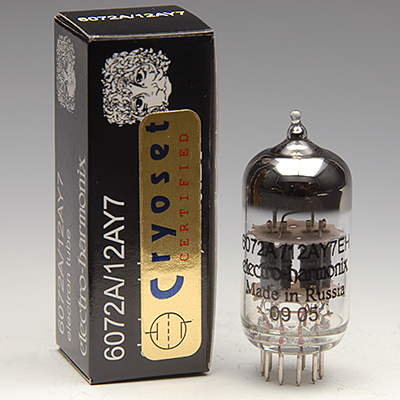
Even a beautiful tube like this Cryogenically treated EH6072 won't correct the circuit gremlins in an APEX 460 and other Chinese mics.
"Just change the tube" all the do-it-your-selfers say.
"I bought a NOS 6072 from like... 1867 and dude it sounds amazing!"
We have done some measurements to try and get to the truth on the matter comparing the original Chinese 12AX7 tube and a couple of different 12AY7/6072 tubes.
Our lab opens the mic and places it in a Faraday Cage to prevent electrical interference. We inject the test signals directly into the mic. preamp so we can measure the electrical characteristics of the preamp without acoustic interaction.
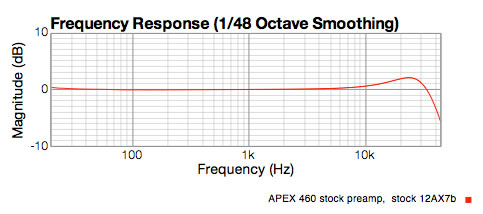
In the graph below you see the electrical response (not acoustic) of the mic preamp of a stock APEX. It looks good in the bottom end but for a micrphone that is said to be too bright, that lift in the high end is completely un-necessary.
So what happens when we put in a good 12AY7 or 6072 tube?
Surprise!
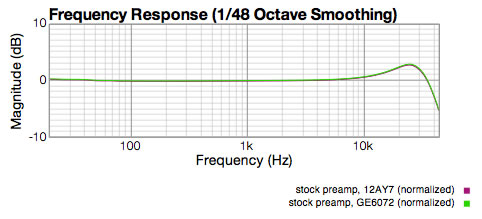
The lift goes UP one more decibel. That's right, changing to a 6072 tube actually increases the high end brightness in the stock circuit. And it doesn't matter if I use an ordinary 12AY7 or a $75 GE "Black Plate" 6072.
Conclusion: The circuit is the problem not the tube.
Techie Note:
This is the result of the much lower output impedance of the 6072 (1/2 the impedance of a 12AX7) driving the transformer and changing the resonance "Q" of the output transformer and the RF "protection" capacitors that APEX puts on the output lines, C9 and C10. By the way I am certain that these capacitors are an error. Their value is much too high for RF decoupling in this circuit. They should 1000 PF maximum, not 0.1uF (same 100,000pF!!)
Can we fix that lift?
Look below at the smooth output of the FAR upgraded preamp.
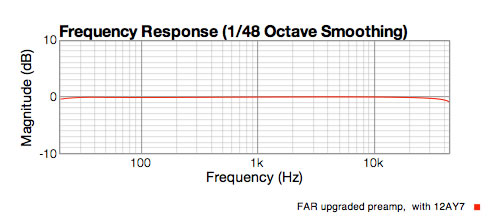
This is using the stock transformer! Now this is more like what you want inside your studio microphone.
With a few simple corrections you get something that is more appropriate for a large diagphragm condenser microphone.
Did you know that the Neumann u47 internal preamp has a flat response out to 40,000 Herz (cycle per second)?
And we haven't told you about the high level of distortion in the stock APEX 460 preamp and how the FAR upgrade reduces it to professional gear levels, giving your mic un-believeable transparency.
Don't be fooled. You can't just change the tube and expect to get the results you want.
To get the inside scoop how to improve your Chinese tube microphone without spending too much, see our paper called:
Comments? Send us a note at:
or post your thoughts on our Facebook page.